Fishing, Birthday Presents, and Starry Nights
Highlights from these photos include fishing with the boys, the arrival of Chuck, Becky's dad's presents (especially a cool new sundial and a bathouse), and some starry night photos down by the dock.


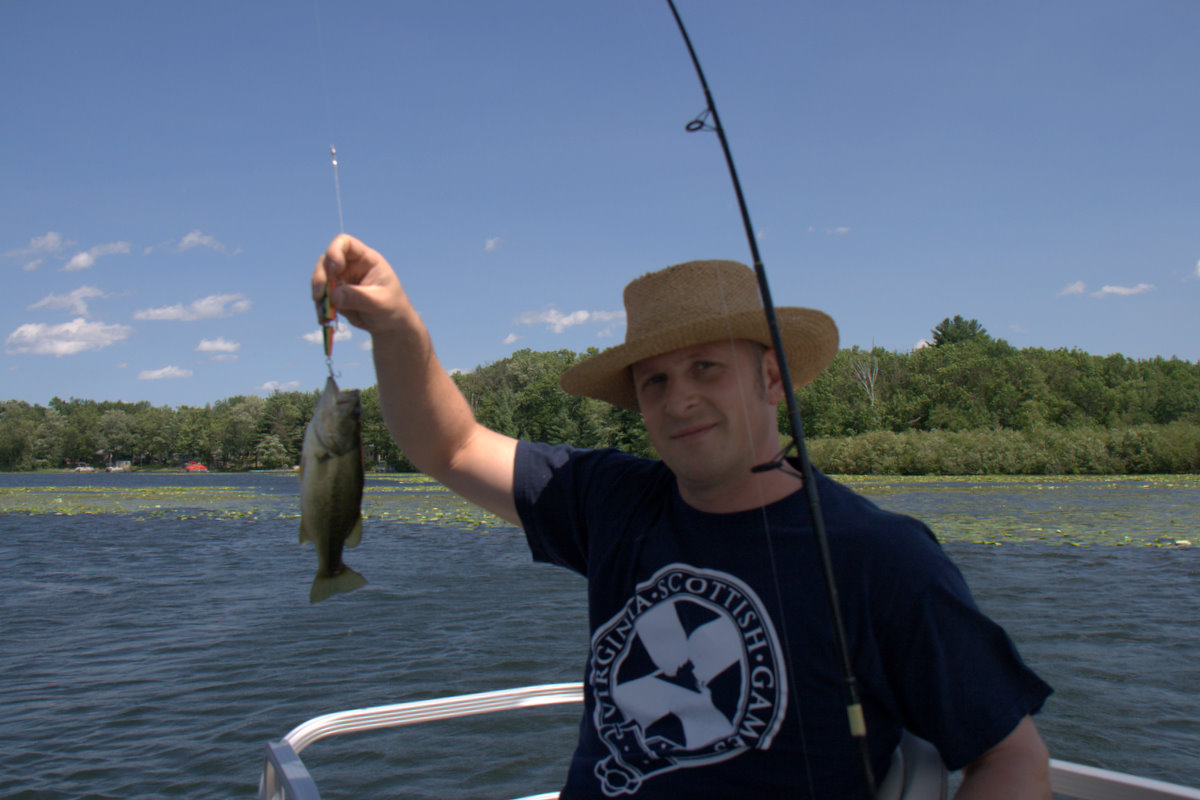


Highlights from these photos include fishing with the boys, the arrival of Chuck, Becky's dad's presents (especially a cool new sundial and a bathouse), and some starry night photos down by the dock.

This was my first attempt at star trail astrophotography. It's pretty obvious which star is the north star in this photo!
EXIF Information: I used a tripod, a shutter release cable, my 18-70mm Sigma zoom lens (set to 18mm), f/5.0, ISO 100, and a 30 minute exposure. Tomorrow, if the weather cooperates, I may try a longer exposure with f/8 to get a little darker image. This one was pretty bright, mostly from the reflection of the dastardly sodium vapor light in my cul-de-sac.

The Astronomy Picture of the Day features Comet Lulin today. Comet Lulin is in the sky right now. If you have a clear night, you should be able to see it tonight. Here's a nice tutorial on how to find it.
Here are some photos from last night's starry sky. Sirius is brightly shining on the lower left, and Rigel forms the bottom corner of Orion's tunic on the right.
In the second photo, all of Orion can be seen, including the magnificent red supergiant, Betelgeuse, on the left shoulder of Orion.

This one is through my standard 50mm telephoto lens. I really should have pulled out my zoom lens, but it was cold, and I wanted to go to bed.
But this one is spectacular. This is from my friend Jeff, who shot through a 4" refractor with his Nikon D70 using 2 second exposures. Click the photo to see it up close; it really is incredible!
I was trying to take a photo of the moon, but I liked how this turned out anyway. The auto-focus picked out the dogwood trees, leaving the cherries, the spruce and the moon blurred. I've noticed that I'm getting a small green reflection (lower left of the moon) with bright points of light in night photos. I think it's from reflections in my UV filter.
Then, once I put the lens on infinity and picked a very short shutter speed, I was able to capture this amazing photo of the moon.
Finally, I tried a couple of sky photos. Here's a composite of Orion. I didn't focus the photo properly, and my hands were sticking to the ice-cold tripod, so I didn't want to play with it too much. The stars look too blurry, but I like how Betelgeuse shows up nice, big and orange. I'm not quite sure what the "eclipse" effect is on some of these stars. (Most notable on Rigel, on the lower right.) If anybody knows, please comment.


Last night, the sunset and moonrise were spectacular. I had to underexpose the second shot to get the moon and all its features.
This, like most of the days at Smoothrock, had no special agenda, no special plans. Our first full day at the lake, we started our exploring in earnest, and made it all the way to Goathead Bay. Goathead Bay promised to be a large hot-spot for walleye, but proved to be less than fruitful for us. Nevertheless, we did manage to catch quite a bit of food, enough that we couldn't finish it all for dinner. Dinner this night was pecan-crusted walleye with buttered noodles and corn. A perfect sunrise to start a perfect day.
Our earliest visitors included several common mergansers.
Nothing, and I mean nothing, tastes better than an early morning cup of camp coffee.
Navigating the lake today to make our way to Goathead Bay (circled).
Enjoying the view and fresh air.
We did get a few spotty showers, so lucky we had our rain gear handy.
Mike from Pipestone came by in the early afternoon to make sure everything was alright. (He caught us conspicuously not fishing! We were playing cards just after lunch.)
Dale with one of his fish. A very respectable northern pike.
We saw lots and lots of bald eagles.
Later that evening, we set up a campfire, and I stood around in the smoke avoiding mosquitoes.
A little froggie I almost stepped on.
By midnight, I was finally able to get a dark enough sky to try some starry night photos. The first one is facing north. Notice the dusky light still prevalent at near midnight? With no moon, it was still bright enough to see by.
Venus
Ursa major
Cassiopeia

Finally, tipsy on whisky, and inspired by Gaz, I tried some long exposure flashlight art. My father was watching me in dumb wonderment as I would fiddle with the camera on the tripod, then walk in front of the camera a few paces, wave my arms madly about, and then return to fidget with the camera. The first was a rather successful Scottish saltire. The second, a pretty sorry (or perhaps, just more abstract) Canadian maple leaf, in honor of our host country.
Here are a set of comparison photos between my old Pentax and the new Lumix. This first photo is a low-light, non-tripod photo of our "orange room." The "orange room" is my standard for measuring noise, since it seems to show up so well in orange. The most obvious difference in the two photos is that the Pentax has less color/saturation than the Lumix. The Lumix is truer to real. The Lumix also has a wider field of view.



"If we are to have peace on earth ... our loyalties must transcend our race, our tribe, our class, and our nation; and this means we must develop a world perspective. No individual can live alone, no nation can live alone, and as long as we try, the more we are going to have war in this world. We must either learn to live together as brothers or we are all going to perish together as fools."
Martin Luther King, Jr. 1967
© Copyright 2005-2014, Scott E. Harris. All Rights Reserved.
Please do not reproduce or copy without the permission of the author.


